
Exchange report · 02
Inside TxFlow's tape
TxFlow is a perp DEX on its own L1, with an API modelled on Hyperliquid's. Its public trade stream names both accounts on every fill, with the fee each side paid. I recorded a Monday of it, plus most of the Sunday before, and checked the bridge on Arbitrum that holds user deposits.
Volume is one-sided (each trade counted once). Trade data: Monday Nov 9, 2026, 00:00–24:00 UTC. My recording covers 182 of the 241 markets that traded that day, about 86% of the day's volume. The account count and the market-maker count come from that recorded tape. For four accounts I also pulled the whole day from TxFlow's public per-account fill history, which covers all 241 markets. Bridge data: from deployment on Mar 9, 2026 to Nov 8, 2026.
TL;DR
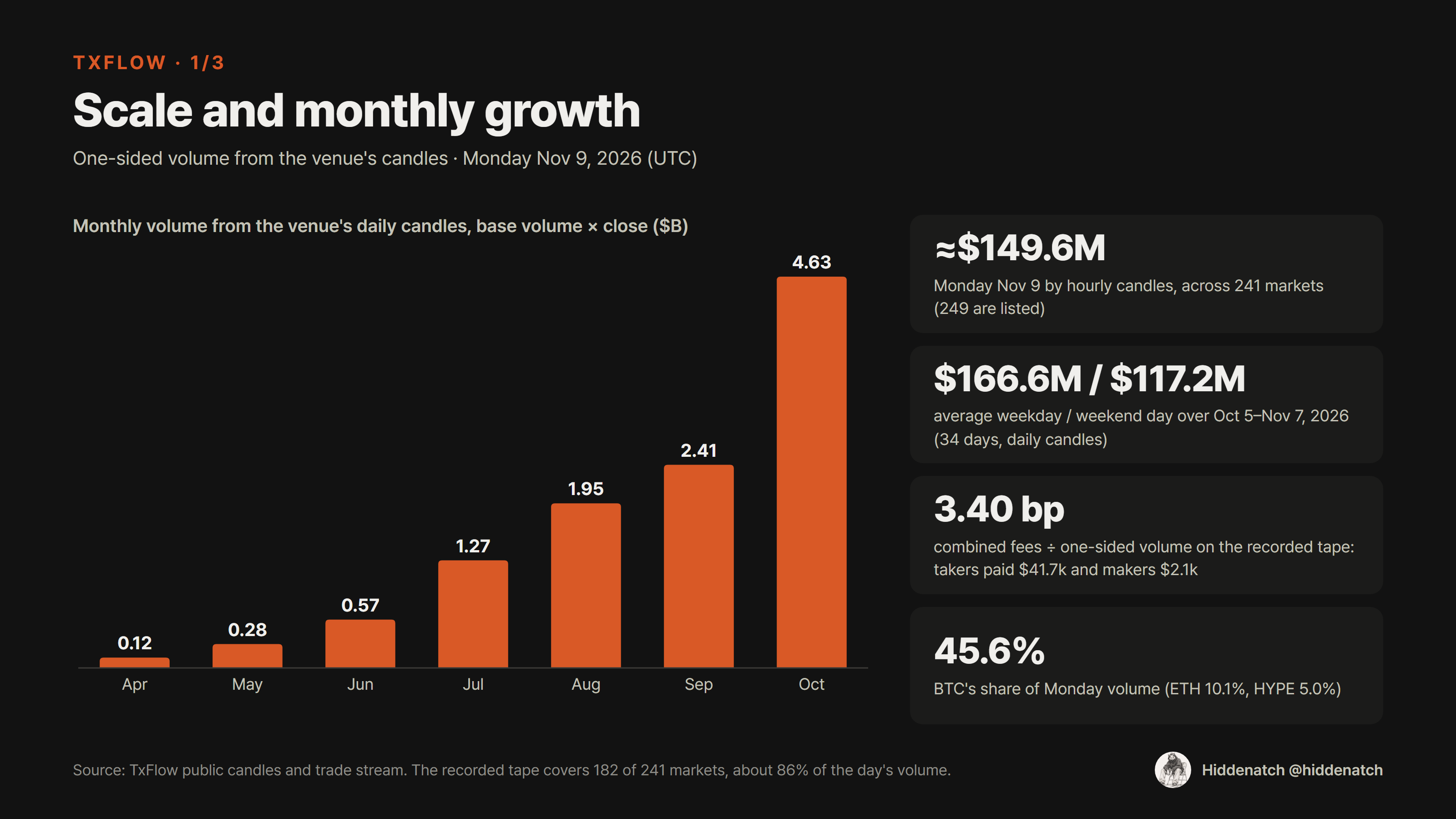
- Monday's volume was about $150M by the venue's candles. Monthly volume grew from $0.12B in April to $4.63B in October.
- On the recorded tape, 10 market-maker-type accounts supply 92% of maker volume. That is normal. Three of them do most of it: across all 241 markets, their maker fills equal about 87% of the day's candle volume, or 85% once the fills among the three are added to the total.
- Those three paid zero maker and zero taker fees on every one of their 1.57 million fills that day. The public fee table has no zero-taker tier, and I could not find the terms.
- One more zero-fee account makes about 92% of the day's trade count (by the candles' count), with an average fill of $3.75. It dominates the number of trades, not the volume.
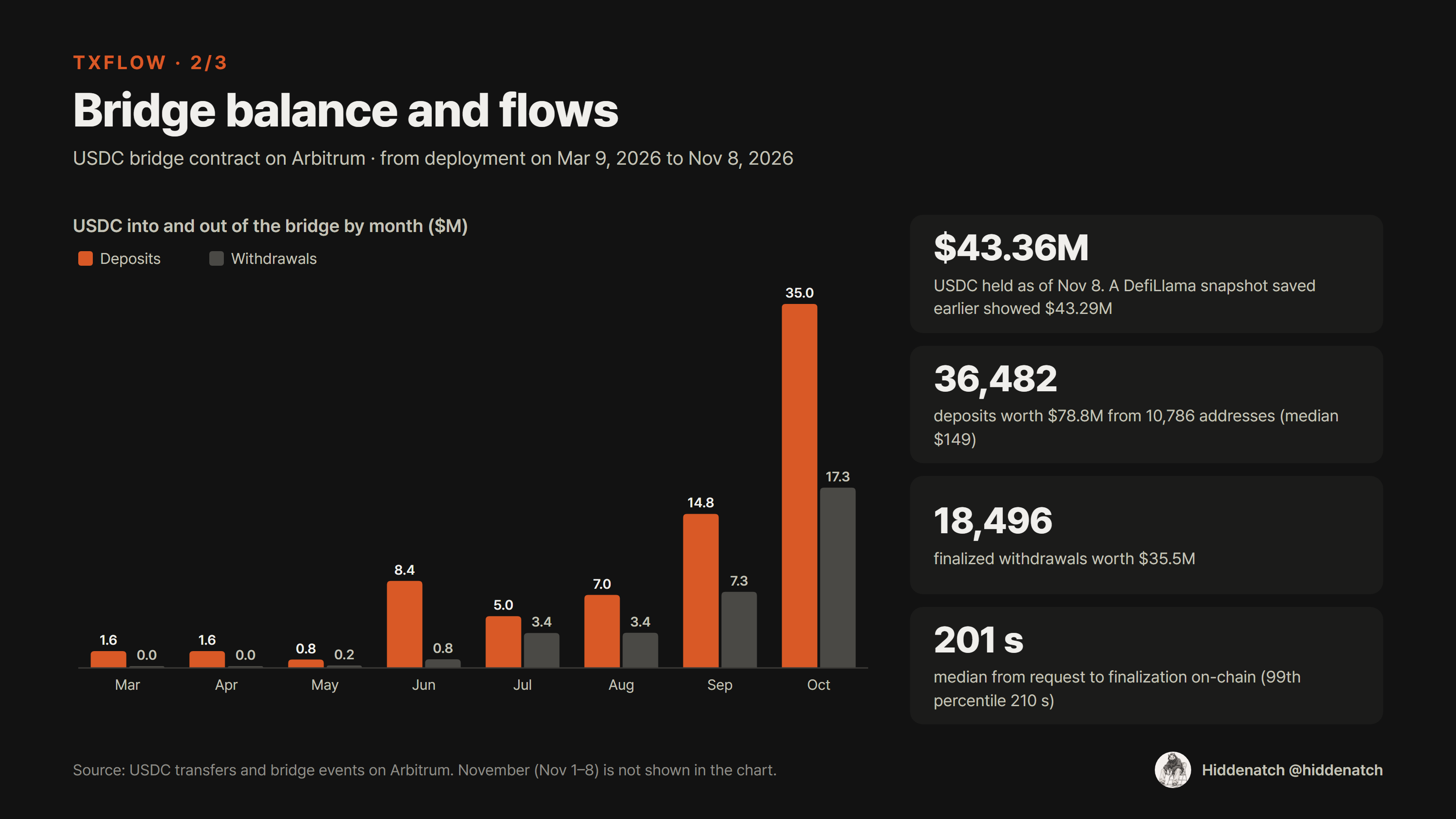
- The bridge held $43.36M of USDC as of Nov 8, close to the $43.29M in a DefiLlama snapshot I saved earlier. Finalized withdrawals took a median of about 201 seconds from request to finalization on-chain.
1. Scale
- Monday, from the venue's hourly candles: about $149.6M across 241 markets (249 are listed).
- By market: BTC 45.6%, ETH 10.1%, HYPE 5.0%, ZEC 4.9%, gold 3.9%, SOL 2.8%.
- Recorded tape: $128.67M, 893,208 fills, 2,350 accounts, in 182 markets. BTC, ETH, SOL, HYPE and gold were recorded almost in full, apart from short reconnect gaps.
- Sunday Nov 8, 04:00–24:00 UTC: $123.3M by candles. Over the previous 34 days (Oct 5 – Nov 7) the daily candles put weekdays at $166.6M a day on average and weekends at $117.2M.
- Monthly volume from the venue's daily candles: April $0.12B, July $1.27B, September $2.41B, October $4.63B.
- Fees on the recorded tape: takers paid $41.7k and makers $2.1k, together 3.40 bp of volume. The entry tier in the public table is 4.5 bp taker plus 1.5 bp maker, so a good share of volume trades at discounted or zero fees.
Open the image version of these charts
2. The money on-chain
User deposits sit in a bridge contract on Arbitrum.
- It holds $43.36M of USDC, counted from the USDC transfers in and out up to Nov 8. The DefiLlama snapshot I saved earlier showed $43.29M.
- All-time: 36,482 deposits worth $78.8M from 10,786 addresses (median $149), and 18,496 withdrawals worth $35.5M. October alone brought in $34.97M, against $39.18M for March through September.
- Withdrawals: 18,498 requests, 18,496 finalized. For those, the median time from request to finalization on-chain is 201 seconds and the 99th percentile is 210 seconds. The longest was about 35 minutes, in a single episode on Oct 29, 2026 in which three withdrawals took more than ten minutes.
- The contract logged 87,849 "FailedWithdrawal" events. Reading the source, these are the relayers retrying (duplicate or early calls), not withdrawals that failed.
- The bridge code is Hyperliquid's Bridge2 with small changes: 645 of 647 code lines are the same. The team has said publicly that it reused the bridge and mirrored the API. OpenZeppelin audited the bridge (report dated Aug 19, 2026).
Open the image version of these charts
3. Market makers
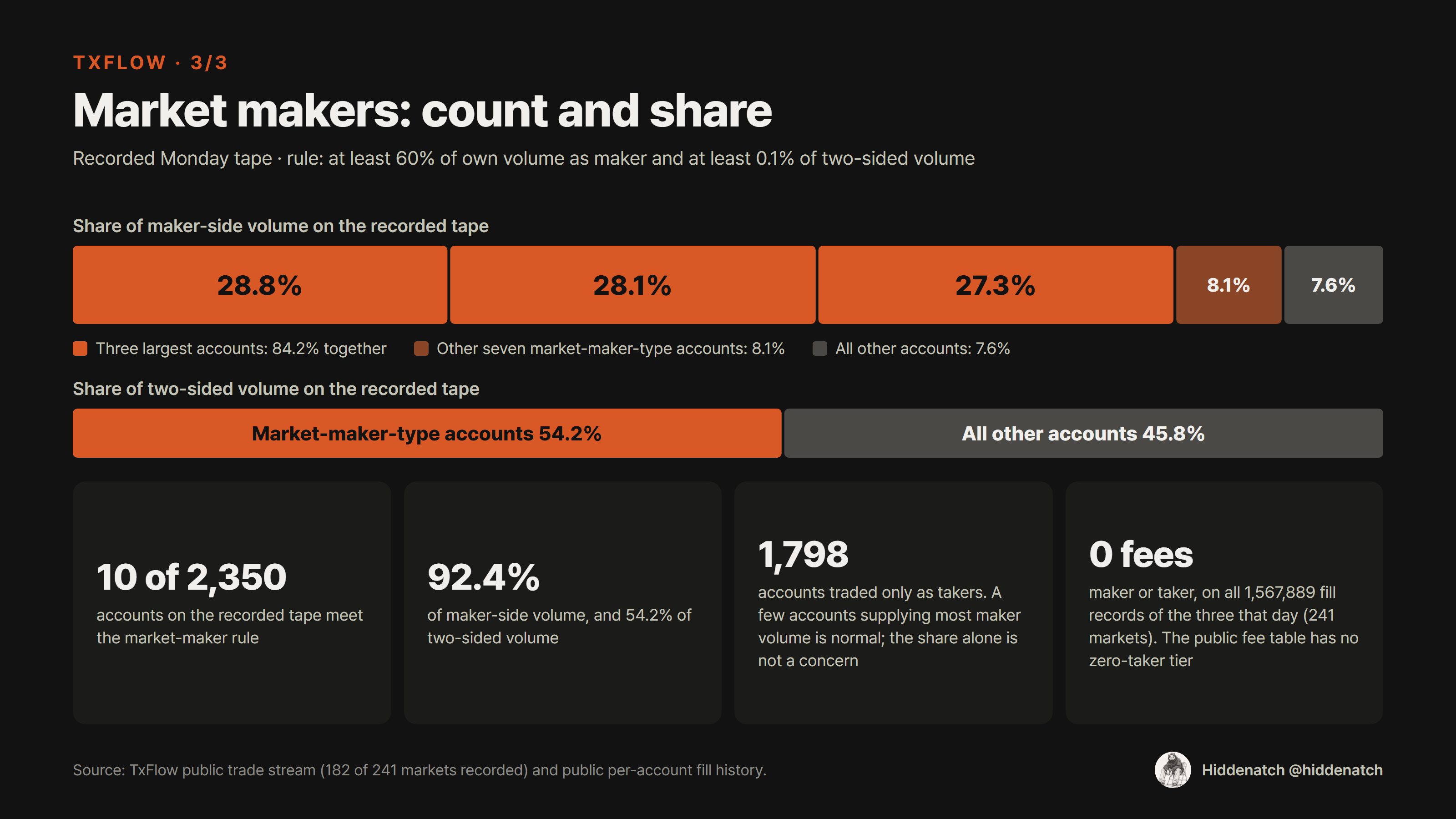
Using this series' common rule (an account whose own volume is at least 60% maker and that is at least 0.1% of two-sided volume), on the recorded tape:
- 10 of the 2,350 accounts qualify.
- Together they are 92.4% of maker-side volume and 54.2% of two-sided volume.
- Three accounts stand out. On the recorded tape they are 28.8%, 28.1% and 27.3% of maker volume, 84.2% together.
- Their full-day fill history, across all 241 markets, gives the same picture: $130.4M of maker fills against $149.6M of candle volume. That is 85–87%, depending on the denominator (section 8). Fills with at least one of the three on one side come to about 98% of the day's volume, counting the fills among the three in the total.
- The fourth-largest account on the tape is 2.9% of two-sided volume and pays non-zero maker and taker fees.
- The share is not a feature of the big markets only. Against candle volume, the three's maker fills are about 83% in BTC, ETH, SOL, HYPE and gold together, and about 96% in the other 236 markets.
- Sunday's recorded tape (03:09–24:00 UTC) looks the same: 9 accounts, 89.9% of maker volume.
Most accounts take: 1,798 of the 2,350 accounts on the recorded tape traded only as takers, and the ten accounts above are the maker on 92% of the recorded volume. A few accounts supplying most of the maker volume is not, by itself, a sign of anything wrong, and I am not flagging the share. The three are also real depositors: each is among the six largest bridge depositors, with $2.9–4.9M.
Open the image version of these charts
4. The three zero-fee accounts: what I checked
Their fee terms are not in the public table. All three paid zero as maker and zero as taker on every fill that day: 1,567,889 fill records across all 241 markets, none with a fee. In the published VIP table, maker fees reach zero at VIP 4, but the lowest taker fee is 2.4 bp at VIP 6. There is no zero-taker tier. The docs' fee schema has a market-maker field, but no terms for it. Fills with a zero taker fee were 17.8% of recorded volume.
They behave alike. Each is about 17% of the day's two-sided volume, measured against the candles. Their own volume is 86%, 83% and 86% maker. Each traded all 241 markets. Whether they belong to one operator or three, I can't tell. Ownership is not verified.
They trade a little with each other. Fills with two of the three on both sides came to 219 fills worth $3.66M, about 2.4% of the day's volume, at zero fee on both sides. On Sunday's recorded tape it was 2.15%. This is small, and it is not same-account self-trading. I don't know the purpose of these fills.
The venue's candles appear to leave those fills out. I compared my tape with the venue's hourly candles, market by market. In 2,790 of the 3,168 market-hours I recorded, the candle's base volume and trade count equal the tape once two things are removed: fills among the three, and one leg of the vault's pass-through fills. The market-hours that do not fit all fall in hours in which my recorder was reconnecting. This is what the numbers fit, not a rule the venue has published, and I found at least one market-hour that follows a different pattern.
What stays open. Who the three are, and on what terms they trade for free. The venue's Season 0 points rules excluded "market makers and vault addresses", so a market-maker designation exists. I did not find the list or the terms in the public docs.
5. The trade count
One account (0x87a8…) made 1,467,971 fills that day, in 240 markets. The venue's candles count 1,596,951 trades for the day, so this one account is about 92% of the trade count.
- Its volume was $5.51M, about 3.7% of the day's volume. The average fill is $3.75 and the median is $2.41.
- It was the taker on every fill and paid zero fees on every one. That is not rounding: on the recorded tape, 4,816 of the 4,818 fills under $5 taken by accounts other than these four paid a taker fee.
- It bought and sold almost equal amounts: $2.76M and $2.75M.
- 98.9% of its volume was against the three accounts above.
- Its share of the venue's candle trade count is much higher outside the main markets: 26% in BTC, ETH, SOL, HYPE and gold together, and 96% in the rest.
- Its fills are spread broadly across markets. The median market had about 6,500, and 201 of the 240 markets had between 5,000 and 9,000. Its five busiest markets together were 3.0% of its fills.
- It had fills throughout the day. Each of the 24 hours has between 55,854 and 70,782 of them, and the quietest minute of the day has 708, counting the account as a whole. That is about 17 fills a second on average. The longest pause between two fills was 8.4 seconds. Every market it traded had fills in all 24 hours.
- About half of its fills (726,390, or 49.5%) are recorded as reduce-only, meaning the order was restricted to reducing or closing an existing position.
- Its buying and selling stayed close in dollar terms within each market. Starting from zero at 00:00 UTC, I added each buy's price × size and subtracted each sell's. The largest running balance in any market, in either direction, was about $4,204, and the median of the per-market maxima was $137. This measures dollar flow, not position size. The fill history does not report opening positions.
- Its reported realized trading PnL was slightly negative: −$2,415 for the day, about 4.4 bp of its volume. Funding and changes in unrealized PnL are not included.
Its fills were typically a few dollars, spread across 240 markets, with fills in every minute of the day for the account as a whole. That pattern is consistent with automation. The public fill history does not show its strategy, its purpose or whether it makes money overall. Its effect is plain: the number of trades on TxFlow says little about how many people are trading, because most of the trades are these few-dollar fills. Its share of volume is small, about 3.7%. Subtracting this account's fill count from the candles' trade count gives about 129,000. The two sources may not count fills the same way, so that is a rough figure and not a measured count of everyone else's trades.
Account map
The accounts from sections 3 to 5 in one picture. Select a box or a label to see the numbers behind it.
The map shows Monday's fills, USDC deposits to the Arbitrum bridge through Nov 8, and the vault leader's reported share of the vault. Trading links, and the grouping of the three zero-fee accounts, do not establish common ownership.
6. What TxFlow does well
- A public tape with both accounts and both fees on every fill. Sections 3 to 5 rest on it and on the public fill history below.
- Public per-account fill history. Any account's fills can be queried without logging in.
- No same-account fills. Zero recorded fills have the same account on both sides.
- The bridge balance can be checked by anyone on Arbitrum. My count of $43.36M is close to the $43.29M DefiLlama showed in the snapshot I saved earlier.
- Fast, steady withdrawals. A 201-second median from request to finalization on-chain, over 18,496 finalized withdrawals, with one episode of up to 35 minutes.
- A candid audit disclosure. TxFlow's own audit page says that some fixes from the OpenZeppelin audit, including the one medium finding, are not in the deployed bridge, because the contract is immutable and a fix needs a migration.
- Stable bridge signers. The signer set has not changed since deployment. The pause and cold-key recovery path was exercised once, before launch, on Mar 24, 2026.
- A bug bounty of up to 150,000 USDC.
7. Open points
- The zero-fee terms (section 4) and the purpose of the high-count account (section 5).
- One address does several jobs. Every oracle update and every global-setting transaction I recorded on Monday came from a single address. The same address is listed first among the bridge's hot signers.
- Who runs the chain. The node software is not public. A team member said on Nov 3, 2026 that TxFlow runs all four replay nodes itself, with community operation on the roadmap.
- Bridge keys. Four hot and four cold signers; three of four are needed. One locker can pause the bridge. The medium audit finding is still unpatched on-chain, by TxFlow's own disclosure.
- Vault concentration. The Protocol Vault holds $13.57M. Its leader address owns 50.4% of the shares and is also the largest bridge depositor, with $7.30M.
- Two small withdrawal requests ($9 and $171.98) name the USDC token contract itself as the destination and have no finalization on-chain. The destination looks like a mistake. The records do not show why these two were never finalized.
- Core audit. The public audit list covers the bridge only.
8. Limits
- One weekday and most of one Sunday.
- The tape is partial. My recorder asked for all 249 trade streams at once, and not every subscription took. It ended up recording 182 of the 241 markets that traded. Measured against the candles, that is about 86% of Monday's volume and 56% of its trade count. The account count, the market-maker count and the fee totals are from that tape, and the venue-wide figures can differ.
- Four accounts are measured venue-wide, from the public per-account fill history. I checked that history against my tape on the five markets I recorded almost in full: every taped fill of the four accounts is in it, and the few extra rows in the history (4 to 14 per account) fall in hours when my recorder was reconnecting. Trade-count shares use the candles' trade count. The three accounts' volume shares are measured against candle volume, which appears to leave out the fills among the three (section 4). Adding those back gives 85%; leaving them out gives 87%.
- The venue-wide volume is my estimate from hourly candles (base volume × the average of open and close).
- The market-maker rule is a simple proxy based on fills. It does not prove continuous quoting or independent ownership.
- Monthly volume is approximated from daily candles (base volume × close).
- Addresses are not people. "Behave alike" is not proof of common ownership.
Nothing here alleges wrongdoing. "Open" means I could not confirm it from public data.
Checkpoints
“Checked” means it was reproduced from public data or read in the venue's public docs. “Partly” means part of it was reproduced and the item says what was not. “Team says” is a statement by the team that was not verified. “Open” means it could not be confirmed from public data; it is not an allegation.
| Item | Status | Basis |
|---|---|---|
| The public trade stream names both accounts on every fill, with the fee each side paid. | Checked | Data |
| Any account's fills can be queried without logging in. | Checked | Data |
| Zero recorded fills have the same account on both sides. | Checked | Data |
| The bridge held $43.36M of USDC as of Nov 8, close to the $43.29M in a DefiLlama snapshot saved earlier. | Checked | Data |
| Finalized withdrawals took a median of 201 seconds from request to finalization on-chain, over 18,496 withdrawals, with one episode of up to about 35 minutes. | Checked | Data |
| The 87,849 “FailedWithdrawal” events are the relayers retrying, not withdrawals that failed. | Checked | Data |
| 10 of the 2,350 accounts on the recorded tape meet the market-maker rule and supply 92.4% of maker-side volume. That is normal. | Checked | Data |
| Across all 241 markets, the three accounts' maker fills equal about 87% of candle-estimated volume, or 85% after adding their among-three fills to the denominator. The share alone is not an issue. | Checked | Data |
| Candle base volume and trade count match the tape in 2,790 of the 3,168 recorded market-hours once the fills among the three and one leg of the vault's pass-through fills are removed. This is what the numbers fit, not a rule the venue has published, and at least one market-hour follows a different pattern. | Partly | Data |
| The bridge signer set has not changed since deployment. | Checked | Data |
| TxFlow's own audit page says some fixes from the OpenZeppelin audit, including the one medium finding, are not in the deployed bridge. | Checked | Docs |
| A bug bounty of up to 150,000 USDC. | Checked | Docs |
| Every oracle update and every global-setting transaction recorded on Monday came from a single address, which is also listed first among the bridge's hot signers. | Checked | Data |
| Vault concentration: the Protocol Vault's leader address owns 50.4% of the shares and is also the largest bridge depositor. | Checked | Data |
| On Nov 9 the high-count account had fills in 240 markets and, for the account as a whole, in all 1,440 minutes of the day. 49.5% of its fills are recorded as reduce-only. Starting from zero at 00:00 UTC, its buy notional minus sell notional reached at most about $4,204, in either direction, in any one market. This measures dollar flow, not position size; the fill history does not report opening positions. | Checked | Data |
| On what terms the three accounts trade at zero maker and zero taker fees. The public fee table has no zero-taker tier. | Open | Data |
| The purpose of the fills among the three: 219 fills worth $3.66M, about 2.4% of the day's volume. These are not same-account self-trades, and common ownership is not verified. | Open | Data |
| The purpose of the account whose 1,467,971 fill-history records equal about 92% of the candles' trade count, with an average fill of $3.75. The two sources may count fills differently. | Open | Data |
| The account count and the market-maker count venue-wide. Both come from a tape that covers 182 of the 241 markets. | Open | Data |
| Who runs the chain. The node software is not public. A team member said on Nov 3, 2026 that TxFlow runs all four replay nodes itself. | Open | Team |
| Why two small withdrawal requests ($9 and $171.98) had no finalization on-chain at the Nov 8 cutoff. Both name the USDC token contract itself as the destination, which looks like a mistake; the records do not show the cause. | Open | Data |
| Core audit: the public audit list covers the bridge only. | Open | Docs |
Sources
- TxFlow public API and WebSocket streams (
rpc.txflow.com): candles, the trade stream, per-account fill history, vault responses and the recorded oracle and global-setting transactions. - Arbitrum One, read from a public RPC: USDC transfers to and from the bridge contract, bridge events and the verified contract source, compared with Hyperliquid's Bridge2 source.
- TxFlow public docs: fee table, audit page, bug bounty and Season 0 points rules.
- OpenZeppelin's bridge audit report, dated Aug 19, 2026.
- A saved DefiLlama snapshot of the bridge balance.
- A team member's public post of Nov 3, 2026 about who runs the replay nodes, read from a dated copy. It is presented as the team's statement.
Volume is one-sided throughout (each trade counted once). The limits of each figure are listed in the Limits section above.